


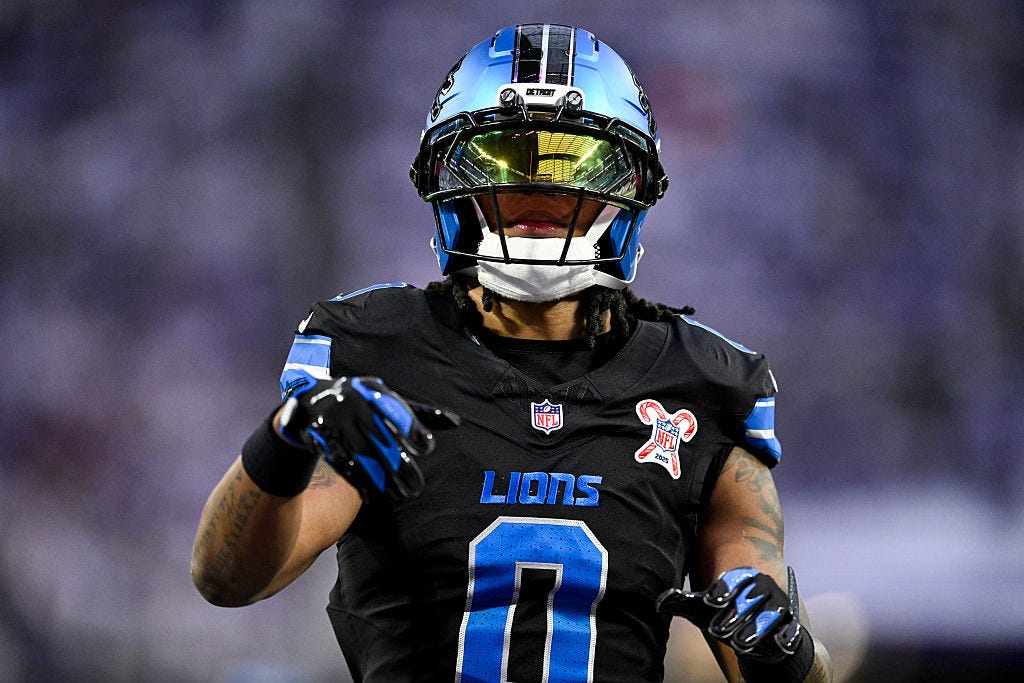
Allen Park — Sometimes it takes weeks for contract numbers to be filed with the league and NFLPA. In the case of Detroit Lions running back Jahmyr Gibbs, we have the complete structure less than a day after the ink dried on his record-setting, three-year extension.
Let’s take a look at those details and explain what it means for both the player and the team.
As a reminder, prior to the agreement, Gibbs was still under contract for two seasons after the team exercised the fifth-year option on his rookie pact earlier in the offseason.
Had Gibbs opted to play under those terms, he would have had a cap hit of $5.7 million this season, nearly 44% of which was a prorated portion of the $9.98 million signing bonus he received in 2023.
Additionally, the fifth-year option for 2027 was a heftier, fully guaranteed $14.3 million — a figure that doubled the past two seasons because Gibbs was selected to a pair of Pro Bowls.
On Thursday, Gibbs scored three additional years worth $67.5 million. The $22.5 million average for the extension is the most ever awarded to a running back, edging out pacts signed earlier in the week by Atlanta’s Bijan Robinson and Indianapolis’ Jonathan Taylor.
Within that $67.5 million, Gibbs received a $15 million signing bonus and nearly $51.5 million in guarantees. There are also incentives that reportedly could drive the total value of the three years to $75.5 million.
Now the important stuff: How the contract breaks down and affects Detroit’s cap from now until 2030.
First, the immediate impact. Gibbs’ cap hit for 2026 modestly jumps from $5.7 million to $8.7 million. That $3 million increase is directly tied to the prorated portion of his new, $15 million signing bonus, which, for cap purposes, is spread evenly over the duration of a contract, up to five seasons.
However, the Lions start to see immediate benefits in 2027. Instead of the $14.3 million cap hit Gibbs would have had playing under the fifth-year option, that number drops to $6.3 million. That frees up critical cap space as Detroit manages the top-heavy construction of its roster.
The new 2027 figure consists of a veteran minimum, $1.26 million base salary, a $3 million proration of his signing bonus, and a prorated portion of a $10 million option bonus, which acts identical to a signing bonus for cap purposes.
Worth mentioning, the Lions tacked on a void year in 2031 to maximize their ability to spread out the option bonus across over five seasons.
In 2028, Gibbs’ cap figure spikes to $15.5 million, which is still a bargain relative to his expected production entering his age 26 season. That figure includes the prorated portions of the signing bonus and 2027 option bonus, plus a $10.25 million base salary and a $250,000 workout bonus.
Everything but $2.25 million of the 2028 base salary is guaranteed up to this point.
Then, as is typical with larger NFL contracts, Gibbs’ deal is backloaded, coinciding with waning guarantees. In 2029 and 2030, he’s scheduled to have cap hits of $27.5 million each year.
However, the dead money plummets at that point. In 2029, it’s $12 million. The following year, as he hits age 28, it’s just $7 million.
That means, come 2029, the Lions have the option to extend Gibbs a second time, lowering those cap hits and deferring more of his money into the future. Or, in the unlikely event his performance sharply declines, or he suffers a career-altering injury, the team can move on and recoup significant cap space — $15.5 million in 2029 or $20.5 million in 2030.
Contrast this reality against the alternative timeline.
Had the Lions played hardball and stayed the course with Gibbs, his cap number would be $3 million less this season, $8 million more in 2027, and, if they relied on the franchise tag in 2028, as some hoped, it would be significantly more than the now-scheduled $15.5 million, when factoring in recent deals signed by Robinson and Taylor this week and whatever top-of-the-market contracts are signed in the next two years.
Make no mistake about it, Gibbs was a big winner this week. He parlayed outstanding, record-breaking production into the most money ever awarded a running back. It was earned and deserved. There should be little debate here.
However, the Lions are winners this week, too. Not only did they lock up their superstar for five seasons, but the franchise also created a much more favorable cap situation the next three years, with real flexibility to adapt in 2029, whether continuing forward with Gibbs — the preferred outcome — or moving on with manageable cap repercussions.
At the risk of answering a question written out of frustration rather than a lack of understanding I’ll take a stab at this.
After over 60 years of poor management (tragically illustrated by the Matt Millen years) the Lions are a serious contender again. That is due to leadership in the front office and development of the players by the coaching staff.
Their ability to identify talent, develop the talent, and retain the talent are the keys to producing a team that can challenge for the Super Bowl for years to come.
The minutiae of the finances are the keys to being able to retain the talent. It was the lack of attention to these details (amongst many other poor decisions) that had left our team without talent and direction for so many years.
For all the (deserved) criticism leveled at the NFL as a soulless money making machine they have created a fantastic product where, because of its structured salary cap, allows teams in small markets (like Detroit) to compete meaningfully with teams in Los Angeles. This allows teams to improve in a short period of time and creates hope among all fans that “this could be the year for (insert favorite team).” It is through the deft manipulation of the salary cap and understanding its byzantine rules that allows for the retention of talent or being able to obtain talent in free agency.
TLDR: money is the life blood of all teams and understanding the rules allows teams to thrive
If you’re a “don’t pay the RB” guy, you have to like this contract. For me, Lions got the best of both worlds since Gibbs has relatively few miles on him and may have a longer productive career than the average back, but they also lowered his cap hit during his prime years, and can move on if he declines after year five or six in the league.