


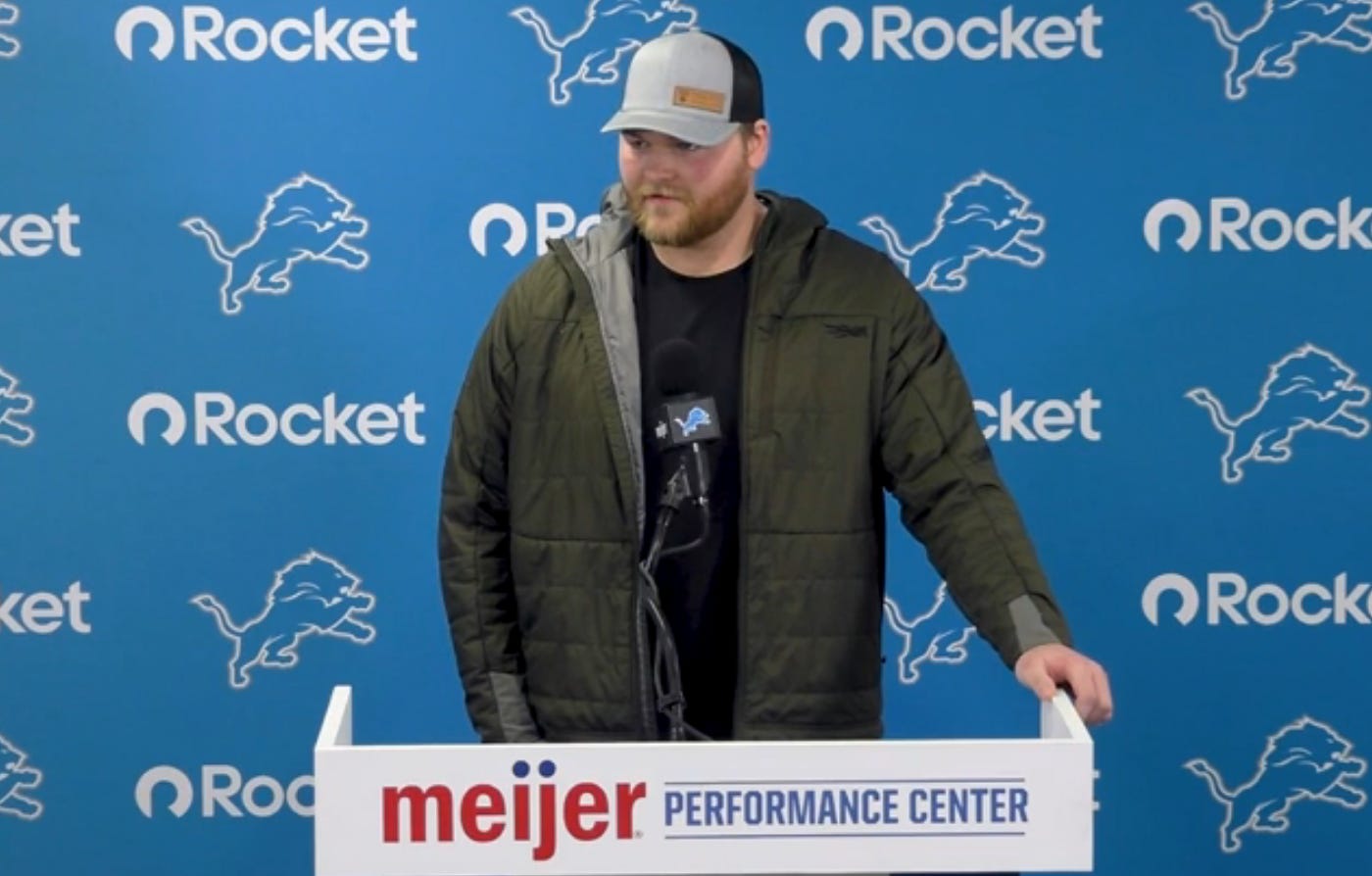
Allen Park — More than a week after coming to terms on a three-year, $25 million contract with the Detroit Lions, the details of offensive lineman Cade Mays’ deal have been filed. And like so many pacts signed by the Lions under current leadership, the structure is interesting and merits some dissection.
NFL contracts are almost never straightforward or evenly distributed across the duration of the deal. Sure, it would be extremely convenient for a three-year, $15 million contract to simply be $5 million per season, but that’s not how it works. In reality, there is salary cap management, inflation, various bonuses and void years to consider.
Let’s start with the basics of Mays’ contract. Don’t worry if the following flurry of numbers gets overwhelming. There will be a condensed recap.
The deal includes a $6.48 million signing bonus and base salaries of $1.215 million in 2026, $7.695 million in 2027 and $1.305 million in 2028. The 2028 salary is supplemented by a $7.39 million option bonus.
Additional bonus money in the contract includes $15,000 per game active, each season, and $50,000 in annual workout bonuses.
Now, here’s where things get a little interesting. Both signing bonuses and option bonuses are cash paid up front. But, for cap purposes, it’s counted in even portions over the remaining duration of the contract, up to five years.
For example. If a player has a $8 million signing bonus and a four-year contract, the bonus counts $2 million against the cap each year of the contract. $8 million divided by four equals $2 million. Simple enough, right?
Well, a relatively new device teams have been using across the league is void years. They are essentially extra seasons at the end of the contract, allowing cap hits tied to bonuses to be stretched further, lowering the immediate cap number.
With Mays’ contract there are four (!) void years. That not only allows the $6.48 million signing bonus to be stretched across a maximum of five years, but the $7.39 million option bonus in 2028, as well, even if that’s the final year the player is technically under contract.
OK, now a summary. As a refresher, a cap hit is the total of all salary and bonus prorations for that season. Meanwhile, dead money is an unerasable cap hit. It’s a combination of remaining bonus prorations and future salary guarantees.
Important to dead money is that it is typically all due as soon as a player is off the roster. That makes the void years interesting, because even though there are four of them, if Mays plays out all three years of his contract, all the remaining dead money accelerates and will count toward Detroit’s cap in 2029.
Now, the year-by-year breakdown of the cap hits:
2026: $2.771 million ($14 million dead money)
$1.215 million base salary, $1.296 million prorated portion of the $6.48 million signing bonus (spread over five years), $210,000 per game roster bonus*, $50,000 workout bonus.
* Mays can earn up to $255,000 in per game bonuses ($15,000 x 17 games). However, because he only played in 14 games last season, that’s considered the “likely to be earned” figure for the upcoming season. If he appears in more or fewer contests, the cap hit will be adjusted at the end of the season.
2027: $9.296 million ($11.184 million dead money)
$7.695 million base salary ($6 million guaranteed), $1.296 million signing bonus proration, $255,000 per game roster bonus, $50,000 workout bonus.
2028: $4.384 million ($3.888 million dead money prior to execution of the option bonus)
$1.305 million base salary, $1.296 million signing bonus proration, $255,000 per game roster bonus, $50,000 workout bonus, $1.478 million prorated portion of a $7.39 million option bonus, spread over five years.
2029: $8.054 million dead money
$2.592 remaining signing bonus prorations, $5.912 million remaining option bonus prorations.
What it all means
The structure of the contract ensures Mays is part of Detroit’s plan for the next two seasons. After that, the franchise will reach a fork in the road, where they will likely either look to move on or extend the relationship.