


Allen Park — Detroit Lions coordinators Kelvin Sheppard, Drew Petzing and Dave Fipp met with the media on Thursday. Here are the noteworthy highlights from those sessions.
Second-year jump
When Sheppard stepped to the podium, I asked him what he learned about his defense since the last time we talked to him, five weeks earlier.
The coordinator said the staff came into training camp with ideas about how things would look, but the schematic vision crystalizes as you see things play out on the practice field. That said, what stood out to Sheppard was how much better his unit was grasping the big-picture concepts of plays, which he refers to as the “why” behind the calls.
Sheppard said that should be the natural progression of any scheme, year one to year two.
“It's the carryover in scheme,” Sheppard said. “Now, it's not so much time on task, trying to get guys to know their assignments, it's now the nuances within it, understanding how teams are going to attack us, understanding the weak points, understanding why we're asking you on this play to leverage it vs. spill it, and so on and so forth. It's just the depths that you're able to get to that takes time. That's with anything really.”
The commentary parallels something coach Dan Campbell has talked about in previous years, comparing player comprehension to college courses, where they’ve moved from 101 introductory levels of understanding to 201, 301 and 401 conceptual thinking.
Later during the news conference, I asked Sheppard how the improved understanding and communication applies to blitzing, which the defense appeared to be doing at a far higher rate during camp than last season.
“Everything that you guys saw on the practice field we had in (the playbook) last year,” Sheppard said. “It's just a matter of what can the players handle again. All this stuff can sound good, look good, it looks exotic, but if three out of 11 have no idea what they're doing when somebody moves, it's all for nothing.
“So, what can the players handle?” Sheppard said. “What is their capacity? And again, these players now are in year two. Even if it may be a new guy, he's standing next to a guy that was here last year, so he was able to get him right like, 'Hey, this is this, go there, go here.'“
Faith in the unknown
Lions fans are understandably skeptical about running back Sione Vaki’s ability to contribute on offense. Entering his third season, he’s logged just 10 touches and didn’t make an appearance in this year’s preseason.
I asked Petzing what Vaki accomplished on the practice field that sparks confidence.
“I think he's done a really nice job from the mental side of things,” Petzing said. “…The run game is there, but for the most part, mentally, that's not taxing. It's either right or left. (He) should be able to handle that for the most part. There's some nuance, in terms of anticipation and reads and ball placement and things like that.
“The protection piece is probably the biggest thing, from a mental standpoint,” Petzing continued. “Defenses, especially in known passing downs, third downs, are going to give you multiple looks and pressure looks and try to put guys' eyes in the wrong spot. I think he's done a really nice job of that mentally. And then there's the physical aspect of being able to step up in the A gap or in the B gap and keep the pocket clean is a big part of being successful on third down in this league.”
Because of a back injury to Isiah Pacheco, Vaki is expected to split reps with Jacob Saylors behind starter Jahmyr Gibbs.
Return men revealed
From the moment the Lions released Greg Dortch, fans wondered who would return punts, even if the answer felt somewhat obvious after the team established its practice squad a day later.
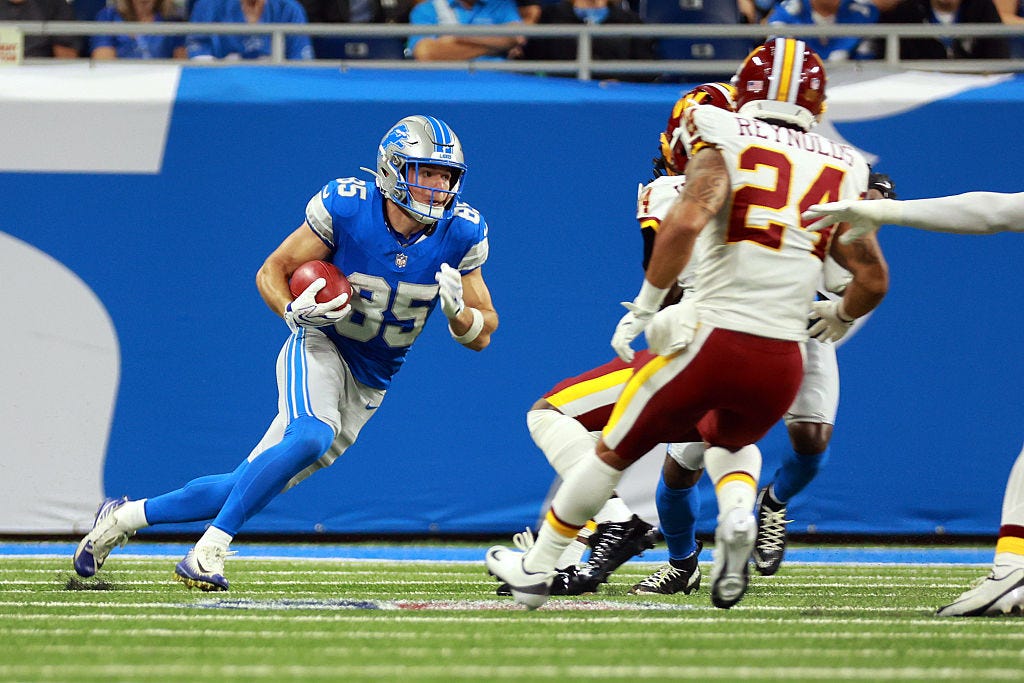
Fipp confirmed suspicions on Thursday, acknowledging veteran Tom Kennedy would not only be fielding punts, but would also be the team’s second kickoff returner, paired with Saylors.
“We’re excited about that,” Fipp said. “It should be great to see. I mean, obviously he’s done it for us a little bit, but we’re excited to see him out there.”
Kennedy, the team’s longest-tenured player between his stints on the practice squad and active roster, has returned only four punts during his career, but flashed potency filling in for Kalif Raymond last season, averaging 16.7 yards on three attempts.
“Every time we put him out there, he’s done something with the ball in his hands, made a little play here or there, kind of created a spark of energy,” Fipp said. “He did that in the preseason again.”
Fipp said the decision of Kennedy over Dortch belonged to general manager Brad Holmes and coach Dan Campbell. The coordinator said he thought both players did a good job throughout the offseason program.
Heart of greatness
Campbell has said in the past that he never wants to take All-Pro receiver Amon-Ra St. Brown for granted. Still, when watching from the outside, it's easy to become conditioned to his consistently high level of play.
Petzing was asked what he’s learned about the player his first offseason working closely with the player. Sometimes, it’s good to hear a new perspective to drive home the uniqueness of St. Brown’s talent.
“He's probably one of the better players I've ever been around,” Petzing said. “I think from a distance, outside the building, maybe it doesn't always jump out, in terms of all the other things that he does at a high level. You see the route running, you see the hands, you see the finish. (It’s) the leadership, the intensity, the physicality to me has blown me away.
“He plays this game at a level that I think so few people are capable or willing to play it from just an attitude and effort standpoint,” Petzing continued. “I think that's one of the reasons he's had the success he had. There's a lot of guys that want to be good in this league, and a lot of guys that have tools to be good in this league, but there's a sacrifice at times that has to get made to actually reach that level. And he's one of the few players that I think does it at such a high level and puts so much into it and truly loves it that has really impressed me.”
Backing Bates
After missing a field goal and two extra points during the preseason, following a 2025 campaign where he converted fewer than 80% of his field-goal tries, some have questioned why Jake Bates remains unchallenged as Detroit’s kicker.
Fipp was adamant in his defense of Bates, referencing flaws in evaluating the position strictly by percentages.
“Jake Bates, kicking in the 40 yard range, he’s exceptionally high,” Fipp said. “He’s above-average. He’s done a nice job. He’s missed three kicks underneath 50 yards, which is good. We want his numbers to continue to improve. We want his short kicks to get better, also, and his long kicks. He's hit, I think, four game-winners, or what turned out to be game-winners, and then two kicks to get us overtime. We won those two games, too. And that's really the big number.”
Fipp isn’t wrong. Bates has converted 94.5% of his kicks inside 50 yards and has not missed inside 40 yards since earning the job ahead of the 2024 season.
In regard to some of the inconsistencies that have shown up in practice and during the preseason, coinciding with Bates’ tweaking his approach, Fipp acknowledged most kickers take around six years before they really reach peak consistency.
“I think historically, if you look at kickers, it doesn’t matter really who, but if you look at those guys, it takes some time to really develop and get into a really good stride,” Fipp said. “These guys always get evaluated by the kicks they don’t make and everybody, whatever, goes crazy. They have a miss and it gives them a reason to freak out. But the truth is, at that position, if you look at all the guys who have really been in the league for a while, all of them probably hit within 5% of each other in a given year. …I see them right in the mix with those guys there and then with a lot of talent upside. Hopefully it continues to improve and get better.”
Comfort with rotation
Rotating offensive linemen during games isn’t new territory for Petzing. He did it multiple times while in Arizona while hunting for the right combination of talent up front. So he’s comfortable going into Week 1 with Christian Mahogany and Ben Bartch splitting reps at left guard as Detroit seeks more clarity regarding its best starting five.
But Petzing is also ready to pull the plug on the rotation if there are unexpected communication breakdowns.
“It’s an opportunity for those guys to continue to compete and earn their reps and to help this team win games,” Petzing said. “So, looking forward to seeing whatever that ends up looking like, one way or the other, playing out on Sunday.”
Bartch has 24 career starts under his belt, but didn’t get a lot of time to show the Lions what he can do because of a lengthy rehab from a 2025 foot injury and a mid-camp concussion.
Still, he showed enough to keep the team intrigued.
“I think we talk about the physicality and the communication, probably the two most important things for an offensive lineman as a starting point outside of just winning your one-on-ones,” Petzing said. “I think he’s done a really nice job of that. He’s a really smart player. He’s played in a couple different offenses and communicates well. The physicality is there, the finish is there, the attitude is there. So, excited to see him compete and he’s done a great job of that throughout camp.”
Setting a baseline
Unlike offense or defense, where the offseason plan is shaped around personnel that’s largely sorted out before cuts at the end of training camp, special teams contributors are clarified much closer to the finish line of the roster’s construction.
Despite the moving pieces, that doesn’t change the standard going into Week 1, but Fipp said the primary objective at the start of the season is to establish a bar for what the unit can be and to work toward that goal as the season progresses.
“Obviously, the goal is to go out there and execute and play at a high level and help your team win,” Fipp said. “But, really the ultimate goal is, OK, set a baseline and a foundation and then let’s get something we can improve on and start getting better. The team that really gets better and better throughout the course of the year, those are the teams that end up being great. The goal is to be great down the stretch. Not that we don’t want to be great early, obviously. We want to start fast and finish faster.”
Fipp noted his groups went through high turnover this year. He’s expecting as many as 11 new players to contribute on special teams who didn’t play in those roles for the team last season.
That includes a guy like rookie edge defender Eric O’Neill, who not only didn’t play special teams for the Lions, but did next to nothing with those groups throughout his college career.
Fipp said his focus during camp is figuring out what players like O’Neill can do, not schematically, but through one-on-one work that typically translates to games.
“For him, it was his ability to play a blocker in coverage, play a blocker and get to the ball carrier was very, very high,” Fipp said. “Usually, the guys who do that in those drills, those are also the same guys that show up in games and make plays in coverage the same way, which he has done also in the (preseason). So, (he) showed up in the drills, showed up in the game, and so you have a pretty good feel for it going in.
“Him, just like all these guys, they're going to have ups and downs,” Fipp said. “They're going to learn, they're going to make mistakes. I always tell these guys, I'm not worried about that. I'm worried about you going out there, you're executing a technique and building a foundation that we can build on. And then, after that first game, we got a chance to get better. You're not going to be perfect in every play. Now, I do expect you to go full speed, do it in a fanatical way. A lot of times that covers up a lot of issues and then we'll work on getting better throughout the course of the year.”
Call me Missouri
Sheppard was impressed by what rookies Skyler Gill-Howard and O’Neill showcased in the preseason.
“I thought it was awesome,” Sheppard said. “I think anybody with a set of eyes could see that these guys were getting after it. And the guys that you just named, that's why they're on the roster. It's a sixth-round pick and an undrafted free agent you just named, by the way.”
But the preseason is the preseason. It doesn’t mean anything now that the regular season has arrived. Sheppard made sure to drive that point home.
“The preseason's over,” Sheppard said. “They haven't played one snap in the National Football League. So all that's potential, all that's hype, all that's rah-rah. We will see September 13th at 1 p.m. what's real and what's not. It’s as simple as that. I'm not going to jump up here and say, "'Oh yeah, we're about to be a dominant front.' I'm not saying that.
“A lot of people say they think I'm from Missouri because you've got to show me,” Sheppard quipped. “Don't sit up here and tell me what you're going to do. We have the ability to play a game where you can show me what you're going to do.”
Evaluation come to fruition
Sheppard is still trying to hammer home the pronunciation of Tyler Shough’s last name, but he doesn’t need any reminders that the second-year quarterback for the Saints will be a tough assignment for his defense.
A second-round pick (No. 40 overall) in 2025, Shough stepped into the starting role midseason and led the Saints to a 5-4 record down the stretch by completing 67.6% of his passes with 10 touchdowns to six interceptions, while also flashing some dual-threat ability.
Shough’s success wasn’t a surprise to Sheppard who remembered reviewing the quarterback’s film ahead of the draft.
“He was a phenomenal prospect coming out (of Louisville)” Sheppard said. “I remember sitting in meetings. We do a lot of crossover examination and I remember (quarterbacks coach) Mark Brunell raving about this kid. I believe, if I'm not mistaken, he had him number one (among quarterback prospects), and there were some pretty good quarterbacks that came out of that group.
“I'm like, ‘Who's that kid?’” Sheppard said. “Then I turn on the tape and I'm like, ‘Oh, that's the kid y'all were talking about, Bru, Dan (Campbell). That’s the kid. Oh, I see it.’ He has all the attributes, man. He’s a big guy. He’s not a small guy, so he can see it, he can feel it, and then he can threaten you with his run ability. I believe two of those five wins, he won with his legs. So that’s something that stands out to me on tape. …He did a tremendous job and I’m hoping he picks up where he left off Week 2, not Week 1.”
The Missouri quote is gold.
Nice article. Thanks, Justin.