


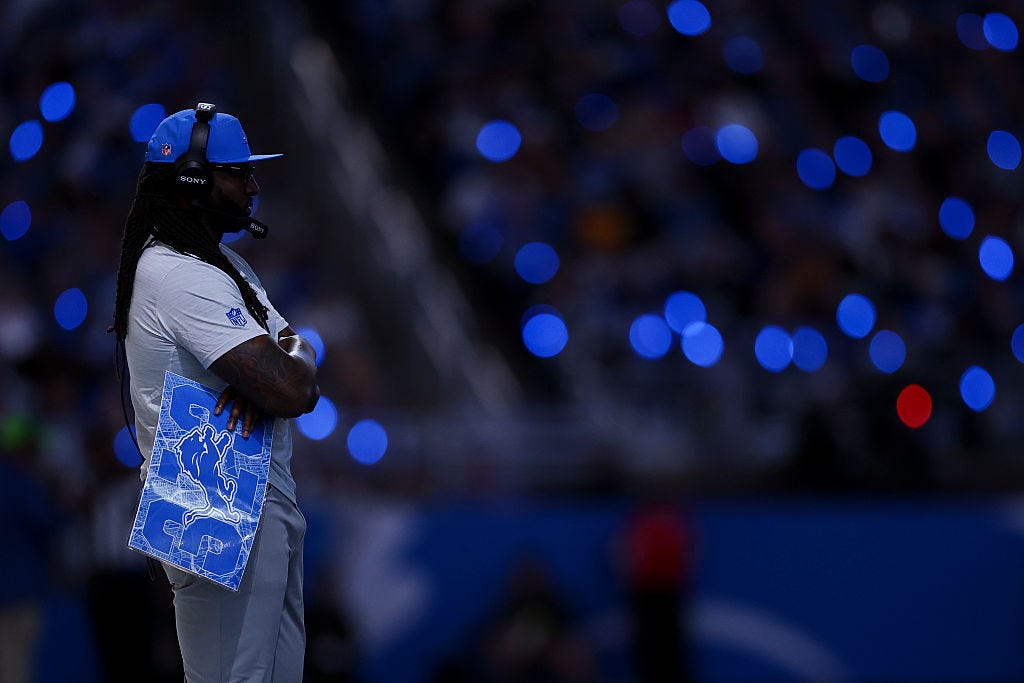
Allen Park — The Detroit Lions defense has been something of an enigma this season.
There are advanced metrics that suggest the unit has played decently. They’re ranked ninth in DVOA — a down-to-down measure of success — while Pro Football Focus grades them as the league’s fourth-best unit.
But the easier to understand statistics — yards, points, third-down and red-zone efficiency — the Lions have taken steps back in each area.
Fan sentiment about the unit and coordinator Kelvin Sheppard has experienced peaks and valleys. In the early stages of the season, some were praising Sheppard as better than his predecessor, Aaron Glenn, culminating in concern that Sheppard could be lost to a head coaching opportunity, particularly when the top job at his alma mater, LSU, came open.
More recently, after a brutal five-game stretch for the defense, there was a segment less concerned he would depart and more than ready to help pack his bags.
In reality, neither outcome was ever particularly realistic. No NFL team or major college program was going to hire Sheppard based on such a small sample size, and coach Dan Campbell wasn’t going to pull the plug on an assistant he’s been helping develop for this opportunity since 2021.
If there was any doubt about the latter, Campbell effectively squashed the possibility during an interview with 97.1-FM earlier this week.
“Shep has really grown this year,” Campbell said on Tuesday. “I think with any first-time coordinator, first-time coach, you go through a lot. You learn along the way. You make adjustments. You find things that you believe in. You throw other things to the side that don’t fit you. You find ways to adjust, and it’s just part of the process. I think Shep’s done a damn good job. There’s always going to be things that you learn from this job, but I like Shep.”
Assuming Campbell doesn’t reverse opinion during a deeper offseason review, the focus shifts to how the Lions defense can improve, because allowing 24.8 points per game, 5.4 yards per play, and a 58.9% success rate in the red zone isn’t going to cut it.
This isn’t the week for unearthing those big-picture answers. The Lions have one more game left, and no matter your feelings about how meaningful that contest is with the team already eliminated from the playoffs, it needs to be played, and the Lions intend to close out their disappointing season on a high note.
Only then will they turn their attention to what’s next. That starts with a comprehensive self-scout, a detailed review of what went well, wrong and why.
On Thursday, I asked Sheppard what that process would look like.
Sheppard said it starts with the individual assistants reviewing the areas they’re in charge of within the defense. For defensive line coach Kacy Rodgers, that’s the run game, while linebackers coach Shaun Dion Hamilton will evaluate the season-long performance defending the play-action pass.
From there, the staff will come together and study the evaluations from a layered perspective of scheme, personnel and execution to determine where improvements can be made.
Sheppard’s top priority is diving deep into the excessive number of explosive plays his group allowed and finding ways to sharply decrease that figure.
“That’s been unacceptable this year,” Sheppard said. “We’re in the bottom tier of the league in that category, and that is number one to playing at a high level on defense. …Then, within that, what is the cause of it?
“For me, I have different categories,” Sheppard said. “Is it something that took place where we’re getting attacked schematically? OK. Is it lack of understanding of the system? A player has repeatedly not been in position on certain plays? And then, (if) it’s the player, is the player in position? Is he at the point of attack and is he losing? And if that’s the case, how many times? That’s the way I think you’re able to evaluate and assess your coaching ability, your scheme’s ability and the player evaluation at the same time.”
For those hoping to see a schematic overhaul, you’re going to be disappointed. Sheppard doesn’t plan to tear down the system the team has built up and modified over the past five years. Rather, he’ll concentrate on tweaks and tightening.
“I don’t see drastic change,” Sheppard said.
In terms of personal growth, Sheppard said he’s learned more about the importance of complementary football. Campbell is focused less on statistics and more on doing what needs to be done that week to win the game, even if it doesn’t look pretty on a box score. That mindset has slowly taken hold for Sheppard.
Sheppard also acknowledged he has room to grow in making in-game adjustments and conveying those expectations to the players.
“The things that I truly learned, to be honest with you, is in the flow of a game, having to adjust on the run,” Sheppard said. “Say you’re going to the game and, ‘This is what we’re doing.’ Well, you can’t be hard-headed. If you get in that game and that’s not working, then what? …That’s kind of what I’ve learned and the ability to go articulate that to the players so they understand me. Not that we’re changing, but why we’re changing, and how we need them to change as the game progresses.”
Like most coaches, Sheppard is reluctant to accept any excuses for the defense’s shortcomings. But he did acknowledge that it’s never easy to overcome the loss of All-Pro-caliber players, particularly when you lose two at the same position like the Lions did at safety this year.
Sheppard said Kerby Joseph, who appeared in just five games this season, often served as an “angel in the outfield” in the secondary, covering up when another defender was beaten in coverage.
Meanwhile, Brian Branch’s absence was felt in the run game as much as against the pass.
“I think we had about seven different safeties start and go out and compete for us this year,” Sheppard said. “And some games, those guys stepped up and played at a high level. And other games, unfortunately we weren’t able to make plays at the point of attack, and we gave up a few more explosive plays than we would like to. I’m not going to sit here and say that’s the reason why this, that or the fourth happened. But I will say whenever you lose All-Pro caliber players, it’s going to affect you in some capacity.”
Whichever way you slice it, Sheppard has an important offseason ahead. His rookie season didn’t go as planned, but perhaps the second-year jump common among players will also show up for the young coordinator.
Have to say, articles like this (and they come regularly) are why I subscribe.
I've noticed a lot of people online interpreting Shepp's comment about not making "drastic change" to mean he doesn't expect to see drastic change in performance. I doubt that's the case. Language is a tricky thing. Thanks for all this context, Justin.