


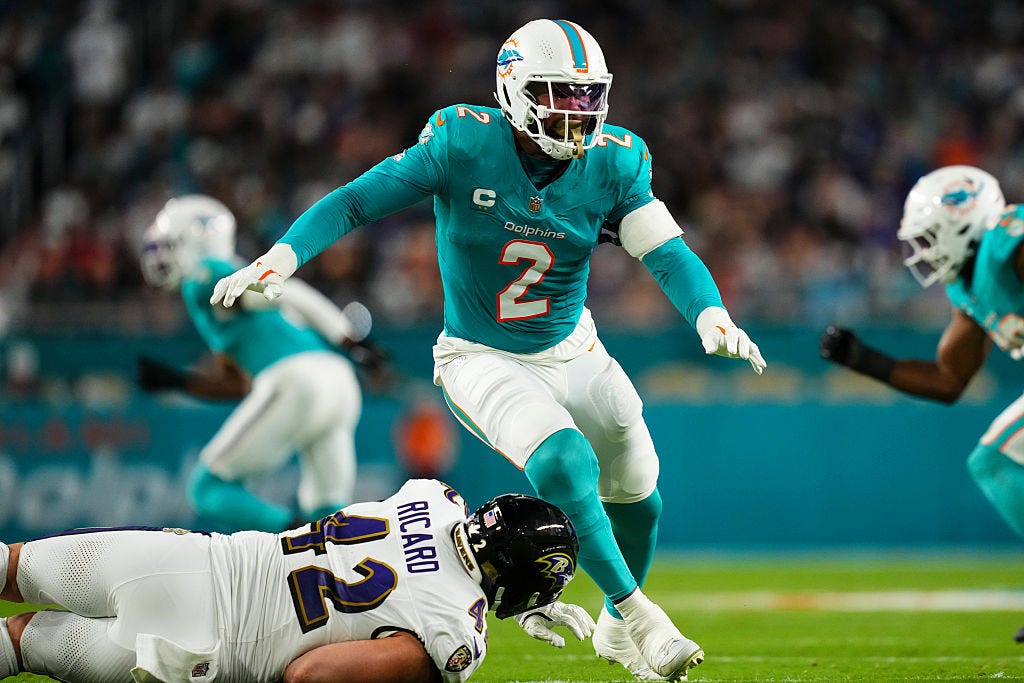
The Miami Dolphins jumpstarted the NFL’s annual roster purge on Monday, releasing four veterans.
By cutting ties with wide receiver Tyreek Hill, defensive end Bradley Chubb, offensive lineman James Daniels and receiver Nick Westbrook-Ikhine, the Dolphins cleared more than $50 million in cap space from the team’s books as the franchise begins a new era under the leadership of first-year general manager Jon-Eric Sullivan and head coach Jeff Hafley.
Known as cap casualties, the releasing of veterans with bloated contracts is standard practice around the league, and often more aggressively done by teams with new leadership.
In 2024, more than 50 vested veterans were released by clubs, which simultaneously altered the landscape of the free agency market. One team’s trash is another’s treasure. Players like Harold Landry, Javon Hargrave and Davante Adams had no issue quickly finding lucrative offers on the open market.
Presumably, the four players released by the Dolphins will also find new homes, although it might take longer for Hill, who is currently recovering from a torn ACL suffered in late September.
Unlike traditional free agency, where players are unable to sign with new teams until their contracts expire in mid-March, players who are cut are free to join another team immediately.
Adams, for example, signed with the Los Angeles Rams on March 9 last year, five days after being cut by the New York Jets and three days before the free-agency signing period opened.
Presumably, the Detroit Lions could have interest in Chubb or Daniels, depending on the asking price.
Chubb, the No. 5 pick in the 2018 draft, has battled injuries throughout his career, but is coming off a campaign where he appeared in all 17 games. The 6-foot-4, 268-pounder who turns 30 in June arguably had some rust after missing the previous season with a torn ACL, but still finished with 47 tackles, 48 quarterback pressures, 8.5 sacks and two forced fumbles.
As for Daniels, he’s started 85 games for three teams since being selected in the second round of the 2018 draft. Notably, the former Iowa Hawkeye missed most of the past two seasons after suffering a ruptured Achilles in 2024 and torn pec last year. When healthy, he brings desirable versatility to the table, having seen playing time at center and both guard spots.
Mostly playing right guard the past four years, Daniels split his playing time between guard and center with the Chicago Bears early in his career.
In terms of Detroit’s potential cap casualties, they don’t have many. The most notable decision the team faces is with center Graham Glasgow, who carries an $8.44 million cap hit entering the final year of his contract, while his release would clear $5.56 million in space.
Under general manager Brad Holmes, Detroit has had at least one cap casualty each offseason. In 2021, his first year at the helm, there was an aggressive roster culling, with cornerbacks Desmond Trufant and Justin Coleman, defensive tackle Danny Shelton, quarterback Chase Daniel, tight end Jesse James, guard Joe Dahl, linebacker Christian Jones and Kerryon Johnson being shown the door.
In subsequent years, there have been fewer cap-related cuts. In 2022, defensive end Trey Flowers was let go. The next year it was defensive tackle Michael Brockers, followed by defensive backs Tracy Walker and Cam Sutton in 2024, although the latter move was necessitated by off-field issues. The Lions also cut two veterans last offseason, defensive end Za’Darius Smith and linebacker Jalen Reeves-Maybin.
While everyone assumes (and wants) Glasgow to be let go, I'd keep him, not as a starter, but as a valuable backup that can play all three interior positions