


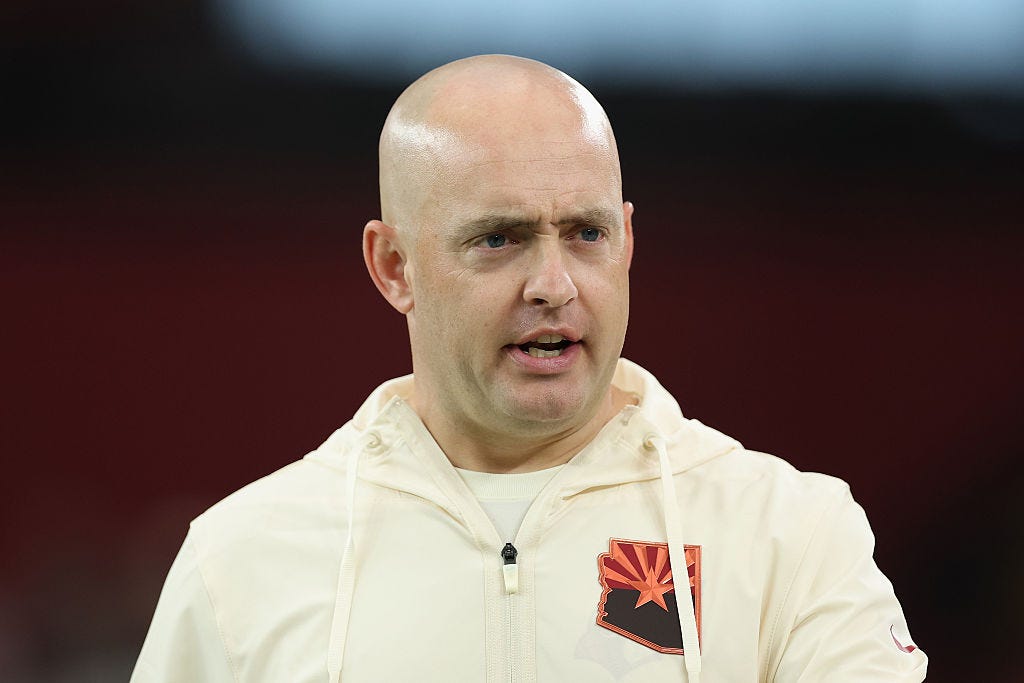
New Detroit Lions offensive coordinator Drew Petzing isn’t scheduled to meet with local media until the scouting combine in Indianapolis later this month. However, he joined the Pride of Detroit podcast this week, providing an initial look at some of his football philosophies.
It’s worth watching the full half-hour conversation, but for those of you who don’t have the time, here’s a distilled version of some of the most interesting comments made by Petzing.
Flexible offense
When trying to figure out what Petzing’s offense might look like in Detroit, it’s easy to flip on the tape from his time with the Arizona Cardinals and try to project how his schemes port. That’s certainly an approach we took, building out a three-part series that explored the coach’s run game, passing attack and red-zone approach.
If you want to read approximately 8,000 words with a bunch of video examples, you can find those tape-based breakdowns here, here and here.
But football isn’t copy-and-paste. Good coaches evolve their schemes to match their personnel, which Petzing said he’s committed to doing in Detroit.
“I think the key to any offense is it’s got to be built around the players you have,” Petzing said. “You’ve got to highlight their ability and what they do best. So, that’s going to be different game to game based on who’s available.
“Every roster I’ve been on, it’s going to be a little different,” Petzing said. “I’ve been very fortunate throughout my career to be around some great coaches who come from different backgrounds and different systems and have different beliefs, and I think I’ve taken a little bit kind of from everybody, in terms of how I want to build things and the language that I go off of and what I believe in.”
Petzing provided two examples of his malleability. The first was making an early adjustment to his run scheme in Arizona.
When he arrived in 2022, he planned to lean on wide zone, much like the Browns had done with great success during his time in Cleveland. It didn’t take long for Petzing to realize what worked for the Browns wasn’t the right fit for the Cardinals.
“Honestly, I thought we were going to be a wide zone team in Arizona,” Petzing said. “And a lot of that first offseason, it was emphasizing wide zone and certain techniques that go with that -- running off the ball, displacement, we just can’t allow penetration, those type of things. And as we got going, I just didn’t feel like we were good enough at it to make it our foundation. And, to me, any good coach, I have to adapt to who we have and what we’re good at.”
The Cardinals would lean on gap and power schemes, building one of the NFL’s most effective rushing attacks his first two years, led by the two best seasons of James Conner’s career.
Then, when Petzing lost Conner and primary backup Trey Benson to injury this season, Petzing once again had to adapt, this time on the fly, leaning more on the team’s passing attack.
“We changed dramatically, philosophy-wise, in terms of what we felt we needed to do to be successful based on who we had available on game day,” Petzing said. “I think, as a play caller, as a coordinator, as a coach, not that you want to be a part of a lot of those (injury situations), but there’s a lot of learning to be done when you are forced with a task like, hey, what we did no longer fits who we have. And it’s Week 6 and we got to figure out a way to score points and try to stay competitive.”
What does it mean for Detroit, specifically regarding the run game? Petzing has already started a deep dive of what the team has utilized the past couple of years, which has been a more zone-heavy attack. The coordinator has no intention of abandoning the things the backs do well, but is looking forward to adding his own twists to the ground game.
“There are things that I want to introduce that I think we’re going to do well,” Petzing said. “I don’t want to talk about them until they show up on tape, unfortunately, but I think it all does come back to kind of that core philosophy at the end of the day. Running the ball is an attitude thing, and it’s about moving people off the line of scrimmage.”
If anything, Petzing still has an affinity for wide zone, even if he shifted away from it while with the Cardinals.
“There is a lot of benefits to the wide zone world,” Petzing said. “You can create great run actions off of it, the keeper game comes off it. You can control the number count a little bit better than you can in some of the other areas. So I think there’s give and take and benefits to both of those (schemes).”
Right man for the job
Petzing was asked why he believed Detroit hired him for the job after talking to a wide array of candidates. Having not sat in on the other interviews, he could only offer his best guess.
“It’s a number of things,” Petzing said. “I think it’s the confidence that I go about the job with. It’s my background in a lot of different rooms. I was a receiver coach, I was a tight end coach, I was a quarterback coach. One of the key points of being an offensive coordinator is that you've got to be in charge of everything and you have to hold people accountable. I think it helps having a diverse background on the offensive side of the ball to be able to do that, because I’ve had to coach the details of how to block wide zone on the front side with a tight end, how to release vs. press as a receiver, where the quarterback’s eyes and where his feet should be in the quarterback room.
“I think that was probably one of those things that I like to think showed through throughout the interview,” Petzing continued. Then, the other part is calling plays for three years, you start to figure out why you’re doing things, how to highlight talent that you do or don’t have. And I think that’s something that hopefully people were able to see throughout my three years there in Arizona. I’m hoping I’m getting better every single game and every year I’m doing it.”
In an introduction video for Petzing sent to season-ticket holders last week, Lions coach Dan Campbell confirmed Petzing’s point about his varied background being a key factor in the hire.
“I think he’s going to fit like a glove. To be a good coordinator, I think you need to know all of it,” Campbell said. “You have to know the run game, you have to know protections, and certainly the passing game. Drew, he checks every one of those boxes, man.”
One of the candidates the Lions passed over to hire Petzing was former Giants offensive coordinator and interim head coach Mike Kafka. A short while later, it was reported that Kafka was also joining Detroit’s staff in a high-ranking offensive role.
Kafka’s title still hasn’t been announced by the team, and there was a suggestion it was because he was being considered for one of the few remaining coordinator vacancies around the league, but Petzing confirmed the two have already been working together at Detroit’s practice facility in Allen Park.
The two go way back, when Kafka had a short stint on Minnesota’s practice squad during his playing career and Petzing was a young coach cutting his teeth with the Vikings.
“Any time, to me, you can add somebody from a different system, with maybe a little bit of a different perspective, who can bring new ideas, who is a good communicator, a good teacher and a great person, I think you’re never going to go wrong when you can do those type of things,” Petzing said.
Heavy 13 personnel usage not a lock
Going back to the first point, about molding a scheme to fit the talent, Petzing was asked about his heavy usage of 13 personnel — three tight end formations — in Arizona and whether we should expect to see an uptick of those packages in Detroit.
Petzing was non-committal, noting you need the right pieces to be able to deploy those looks. If you lack three versatile tight ends, the value isn’t there. He also explained what he likes about the schematic wrinkle that gained extra attention this past season after Sean McVay embraced using 13 personnel to great success in Los Angeles.
“When you have guys that can do a lot of different things, you can start to dictate things based on what the defense wants to do,” Petzing said. “I think as the game has evolve defensively over the last, call it five or seven years, you’re starting to see more and more different defensive personnel. It’s not just, ‘Hey, we got base, we got nickel. Here we go. This is it.’ You’re seeing different variations of base and different variations of nickel, and people finding more creative ways to change the front in nickel. It’s not always a four-down over (front) that you started to see there 10 years ago.
“So, when teams want to do that, well, now in 13 personnel, you have to be able to deal with everybody in the box and multiple gaps that you weren’t ready to account for,” Petzing continued. “Then if you get big (defensively), I can spread things out and (get) people that you don’t want to have in space. So it allows you to dictate to the defense a little bit more, some of those things that they have been trying to dictate to us based on who they’re putting on the field. And it gives you the freedom to jump back and forth without being predictable.”
Love for QB1
The key to any coordinator’s success is going to be the play of his quarterback. It’s safe to say Petzing is enamored with the one he’s inheriting in Detroit.
This might be some of the highest praise you’ll ever read about Jared Goff.
“He’s as impressive as a quarterback as I’ve seen watching tape,” Petzing said. “I think it’s one of those things that when you’re not in the division, and we played him two years ago, but we didn’t have a ton of overlap. So you see him, you watch a couple of games on TV here and there and you’re like, ‘Oh, it seems like he’s playing well.’
“Coming into the interview process and watching the tape, I think you start to really appreciate how good he really is and what level he’s been playing at these last couple of years,” Petzing continued. “I think as a play-caller, as a coach, really at any position on offense, when you have a guy that sees the game the way he does, that can operate the way he does, the rhythm and the timing and the vision is really impressive. Then having the physical tools to then put the ball where it needs to be placed, to have touch, but also have some violence in his throwing motion.”
In a game that has evolved to embrace dual-threats at the QB position, Goff feels like a dying breed of pure pocket passers. Petzing doesn’t mind. He believes games are won in the pocket, and the coach is confident in his quarterback’s ability to execute outside the tackles.
“Yes, he’s a pocket passer, but he’s made some great plays in the keeper game, on the move,” Petzing said. “There’s just so many things that I think he does at a really high level that, again, it all goes back to what puts stress on a defense. And when you know a guy can see the field, check in and out of plays, get in and out of the huddle, like those are little things that I think get taken for granted at times that really make a massive difference in how an offense operates and the success of a team. I think he’s done that at such a high level for such a long time.”
Petzing also spoke glowingly about his early interactions with Goff, noting excitement for the give-and-take they will have as they build the system around the veteran quarterback.
“I think that has to be that way with whoever the guy,” Petzing said. “In this case, Jared is going to have the ball in his hand. He needs to know the whys, he needs to know the intricacy, and he needs to have a voice. He needs to speak up when he — and he’s he will do a great job of that because I know him at this point a little bit — like ‘I’m not comfortable that. I don’t like that. I want this. Do we think this is good? Hey, push me on this.’ And I’m going to. In a lot of ways. To me, with a good quarterback-play caller relationship, he’s another coordinator on staff.
…Everything we do has to be based around his skill set, making him comfortable, allowing him to see the game the way that he thinks he sees it best,” Petzing said. “And then I can do some things and involve some things that, ‘Hey, you haven’t done this, but I think this is going to fit really well. Here’s why, here’s how, let’s take a look at it.’”
Field-level view
There are successful coordinators who coach from the sideline and successful coordinators who coach from the booth, but as outside frustrations grew with Petzing’s predecessor, John Morton’s decision to call games from upstairs was often a point of consternation.
Petzing said he’s tried both approaches, and might go that route during the upcoming preseason, but he sounds like a man who expects to be on the sideline once the regular season begins.
“I got the sense the communication was easier down, really, with the quarterback,” Petzing said. “When you’re up, it’s a little bit harder to have quick conversation. I can’t say one-offs. I can’t do that. I got a little removed.
“Some people do it, do a really good job of it,” Petzing said. “For me, I was better suited on the sideline. I also caught myself watching the game more than I like to watch it from the booth. Whereas down on the sideline, I’m kind of like looking at things, understanding where things are at, but I’m able to process a little bit faster and move on.”
The fact he signed up to go on the record on a podcast and answer questions on the spot says a lot about his confidence with knowledge of the game and his ability to think on the fly. Both of which are probably the two most important traits for a coordinator to have. The more I hear him speak the more I like the pick. At this point, and with no offense to Morton, but I’m feeling like it’s a big upgrade from this time last year. Petzing appears to be well equipped with his faculties. I’m
hopeful.
Smart and experienced guy, obviously. I like his commitment to flexibility and understanding the need to constantly be one step ahead of ever-shifting D philosophies. Great communicator, sounds like. That’s key.